

Lawrence McGeein was a popular 17-year-old teenager in Portsmouth Village. In 1942 he drowned while trying to save three airmen from Britain’s Royal Navy that capsized their canoe off Portsmouth Harbour.
Portsmouth Village was first settled in 1784. In the early 1800’s it was known as ‘Hatter’s Bay’. It has a long history and became part of the City of Kingston in 1952.
Over the years it was home to Kingston Penitentiary, the Prison for Women and the Rockwood Asylum. It was hardly a sleepy little village.
One of the darkest days in its long history happened during WWII on the night of June 16, 1942 when a canoeing accident claimed the lives of three young men, including Lawrence McGeein.
A well-liked, 17-year-old from the village, McGeein died in a valiant effort to save three airmen in distress.
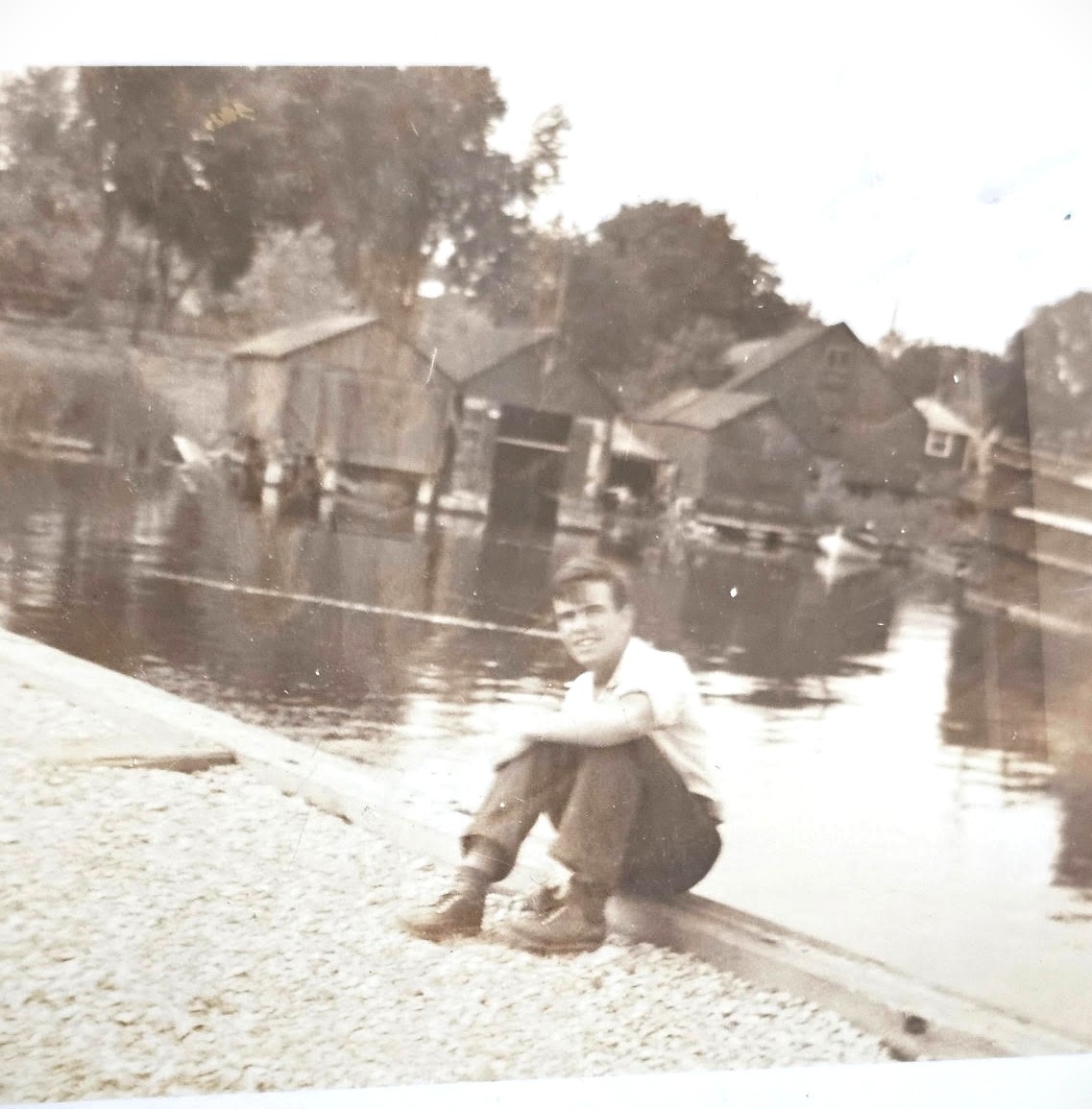
Considered an exceptional athlete, as well as a talented artist, McGeein’s nickname was ‘Tunney’, after Gene Tunney – boxing’s heavyweight champion in the 1920’s. His Portsmouth friends & family pronounced his nickname Toonie (Tune-EE) and it was often spelled as Toonie.
The McGeein family lived at 13 John Street, later renamed Grange Street.
McGeein was a fixture at the Portsmouth Pier. A very strong swimmer he won several medals in local swimming competitions and also enjoyed being out on a 20-foot sailboat that he built himself.

On that fateful night in June, three naval airmen came to Portsmouth Harbour to rent a canoe. They had just arrived in Kingston from Great Britain to train at Norman Rogers airport with the Fleet Air Arm – the aviation branch of the Royal Navy.
The sun was beginning to set over Portsmouth on a nice summer evening. Bill Westlake, the owner of the Westlake Boat Livery, set them up with a small canoe that was equipped with a sail. They planned to do a short trip along the Kingston shoreline before dark.
The airmen left the harbour and paddled their canoe east – past Kingston Penitentiary. They weren’t gone long when a sudden, violent storm squall blew across Lake Ontario and their canoe capsized.
Their cries for help could be heard from shore and without hesitation Portsmouth teen Lawrence McGeein jumped into his homemade sailboat to try and assist.
With darkness setting in, McGeein headed out into the stormy waters where his sailboat was blown off course and capsized before he could reach the overturned canoe. It is believed McGeein was attempting to swim back to shore when he perished in the high winds and unforgiving waves.
Two R.A.F. Flight Sargeants stationed at Kingston airport happened to be at Portsmouth Harbour. They had a sailboat with a small outboard motor and when they learned three fellow airmen were in danger, they headed out into the night to search for them.
The weather had let up and armed with a small spotlight they began their search. About a half a mile offshore east of Kingston Pen they located the downed canoe. It was pitch dark and after 10:00pm. There was no sign of McGeein or his sailboat.
Two exhausted survivors were still clinging to the canoe and the third man had gone missing. They pulled the two airmen out of the dark waters. Richard Rowley appeared to be in grave condition and died on his way to hospital. Godfrey Askew was missing and presumed drowned. Ian H. Martin was the lone survivor.
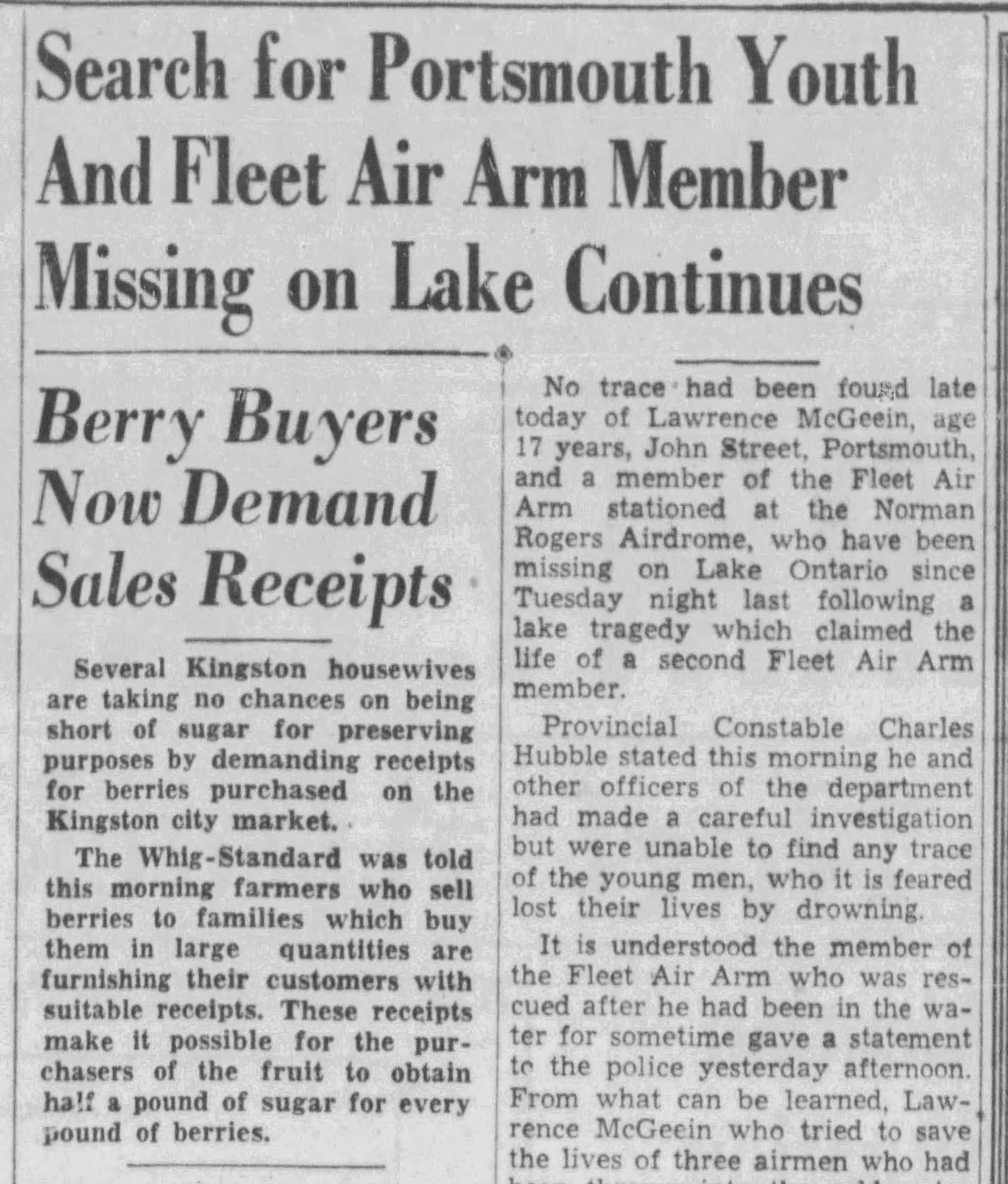
At daylight the next morning a tanker ship in the south channel of Wolfe Island located McGeein’s sailboat. It was found 15 miles from where the accident occurred, near Cape Vincent, NY, an indication of just how powerful the storm had been. The boat was recovered by the U.S. Coast Guard out of Sacketts Harbour, NY.

A week later the rented canoe from Westlake Boat Livery was located near Amherst Island.
The body of Mr. McGeein was recovered exactly one month after the accident, on the shores of Howe Island. He was buried the following day at St. Mary’s Cemetery.
In early August the missing British airman, Godfrey Askew, was discovered about a mile from the ferry dock on Wolfe Island.
Three young lives were lost on that tragic June night.
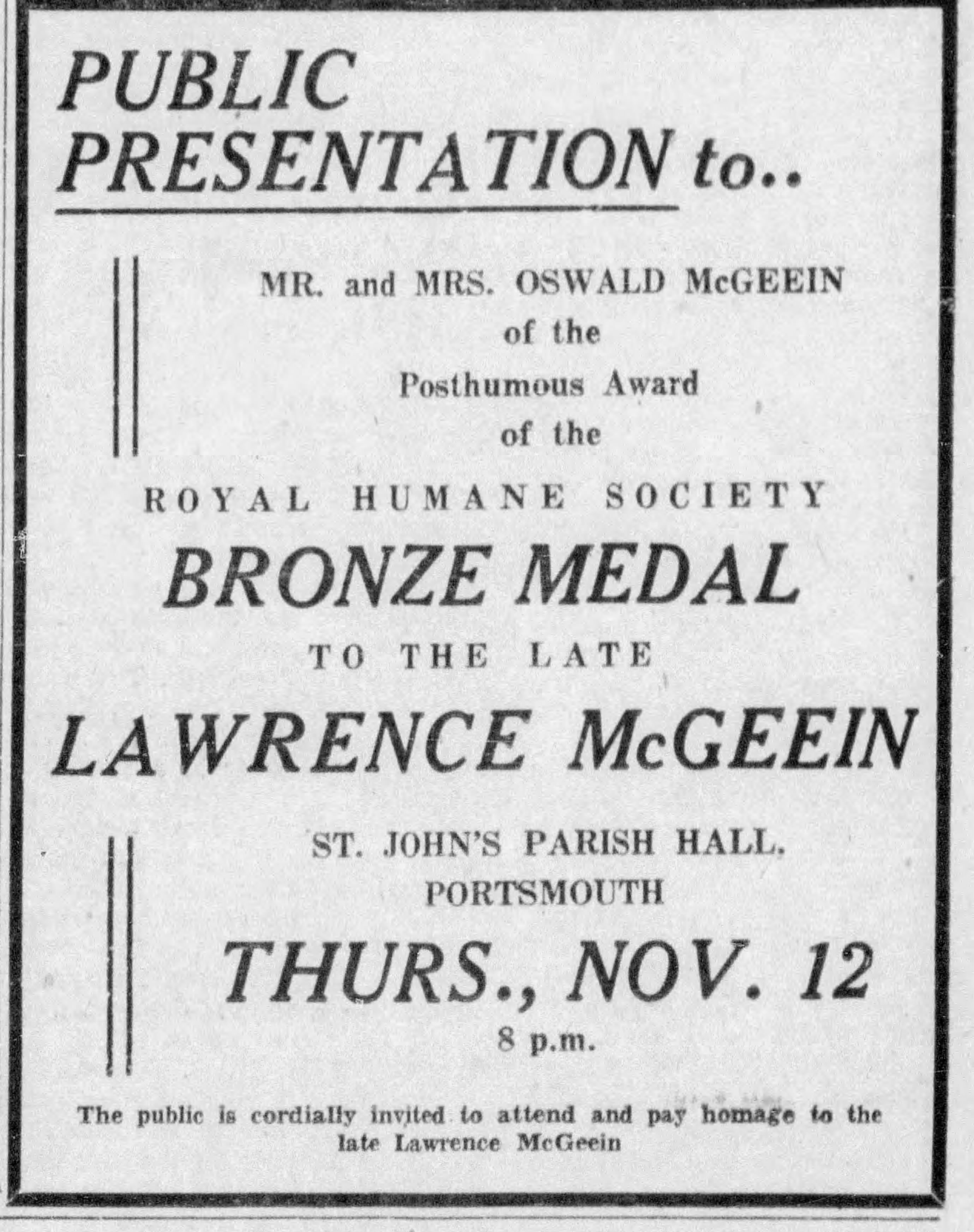
On November 12th the village gathered to honour one of its own. Lawrence McGeein posthumously received the Bronze Medal of Bravery from The Royal Canadian Humane Society, an organization that honours those for acts of heroism and bravery in saving human life.
Mr. McGeein and his family belonged to the The Church Of The Good Thief in Portsmouth. With a very large crowd expected, St. John’s Anglican Church in Portsmouth offered to open its doors to host the ceremony to honour the life and bravery of Lawrence in the parish hall at St. John’s.
It was an overflow crowd of family, friends and villagers. The three local churches all participated, Father Brady from The Church Of The Good Thief, Canon Smart from St. John’s and Rev Dr. J.D. Ellis from Portsmouth United Church.
Father Brady reflected on a young life cut short telling the crowd of villagers, “Lawrence had expressed an interest to join the Navy, but he was too young. He did not know that before he could join he would make the supreme sacrifice for King and country.”
Former Portsmouth Reeve Murdoch Johnston presented the Bronze Medal of Bravery to his mother, Mrs. Margaret McGeein, in an emotional ceremony.
The following year in 1943, an Honour Roll was created for the 107 men and women that joined the armed forces from Portsmouth Village and it was displayed at the Portsmouth Town Hall.
Lawrence McGeein was the only civilian on the Portsmouth Honour Roll in recognition of his bravery and sacrifice.
McGeein is one of only two civilians recognized on the Military Wall of Honour at the Kingston Memorial Centre.
The other civilian is Norman Rogers, the former Member of Parliament for Kingston and Minister of Defense. Rogers died in a plane crash in 1940 while serving in Parliament.

In the 1980’s Kingston Whig Standard columnist Lyndon Jones ran a brief story recalling the Portsmouth tragedy from 45-years earlier.
Kingston’s Dan Chalmers read it and shared his own story. Chalmers and his wife Sharron visited Santa Barbara, California in 1981 and while touring a museum they mentioned to a volunteer they were from Kingston. The volunteer looked startled.
She was living in Britain in 1942, but her fiancé was one of the airmen that drowned off Portsmouth Harbour. He was twenty years old and had arrived in Kingston the day before his tragic passing. Years later the woman said she made a pilgrimage to Kingston to visit the grave of Godfrey Askew, the man she was going to marry – laid to rest at Cataraqui Cemetery.
Lawrence McGeein worked at MacLachlan Lumber and left behind his family in Portsmouth, his parents Oswald and Margaret and four siblings. Oswald would pass away a year later in July 1943.
Lawrence had three brothers, Merne, who was serving overseas, Charles was with R.C.O.C. in Ottawa – providing supplies and support to our military. Charles went on to be a Corrections Officer in Kingston. Joseph (Jake) McGeein would become a longtime Kingston firefighter. Mary was Toonie’s only sister.
Mary Granger had a long career as an RN at the Ontario Psychiatric Hospital in Portsmouth. Along with her husband Earl, a hard working stone mason, they raised five kids and lived on Grange Street in Portsmouth.
Just a few hundred yards away from Portsmouth Harbour where Mary’s brother Lawrence died a hero at the age of seventeen.
It is an honour to share the heroic story of Lawrence McGeein. Growing up in Portsmouth I knew Toonie’s Mom, his sister Mary and two of his brothers, Charles and Jake. His nephew Joe Granger is a lifelong friend. Mark Potter

 KTown Sports Blog
Remember hearing about it.
LikeLike
Thanks Mark Potter for sharing this story.
LikeLike
I have heard many stories about Portsmouth Village back in the day. The McGeeins stand out – serving overseas, RCOC, fireman, RN and Lawrence trying to save lives.
Serving and helping others was in their DNA.
Thanks for this Mark.
Don McEwen
LikeLiked by 1 person
A great Portsmouth family! Thanks Don!
LikeLike