

What is your definition of a high achiever? How about a Queen’s student who in the 1940’s excelled playing three varsity sports and still found time to earn a medical degree.
That student, a lifelong learner, was Kingston’s H. Gerald ‘Doc’ Wagar, an outstanding student athlete who played varsity hockey, football and tennis while attending Queen’s School of Medicine. Often, he would play a football game in the afternoon at Richardson Stadium and then head to the Jock Harty Arena to play an intercollegiate Queen’s hockey game.
The late Stu Crawford was a teammate of Wagar’s on the hockey Gaels, he reflected back on what he learned from him, “Gerry taught me more tactical things, strategy, little hints on positioning and reading the play, just by being around him, he sees a whole different game than most people,” Crawford said in a Whig Standard interview.
In 2000, Wagar was named winner of the ‘Gael Force’ award as the university’s top varsity hockey player for the decade of the 1940s.
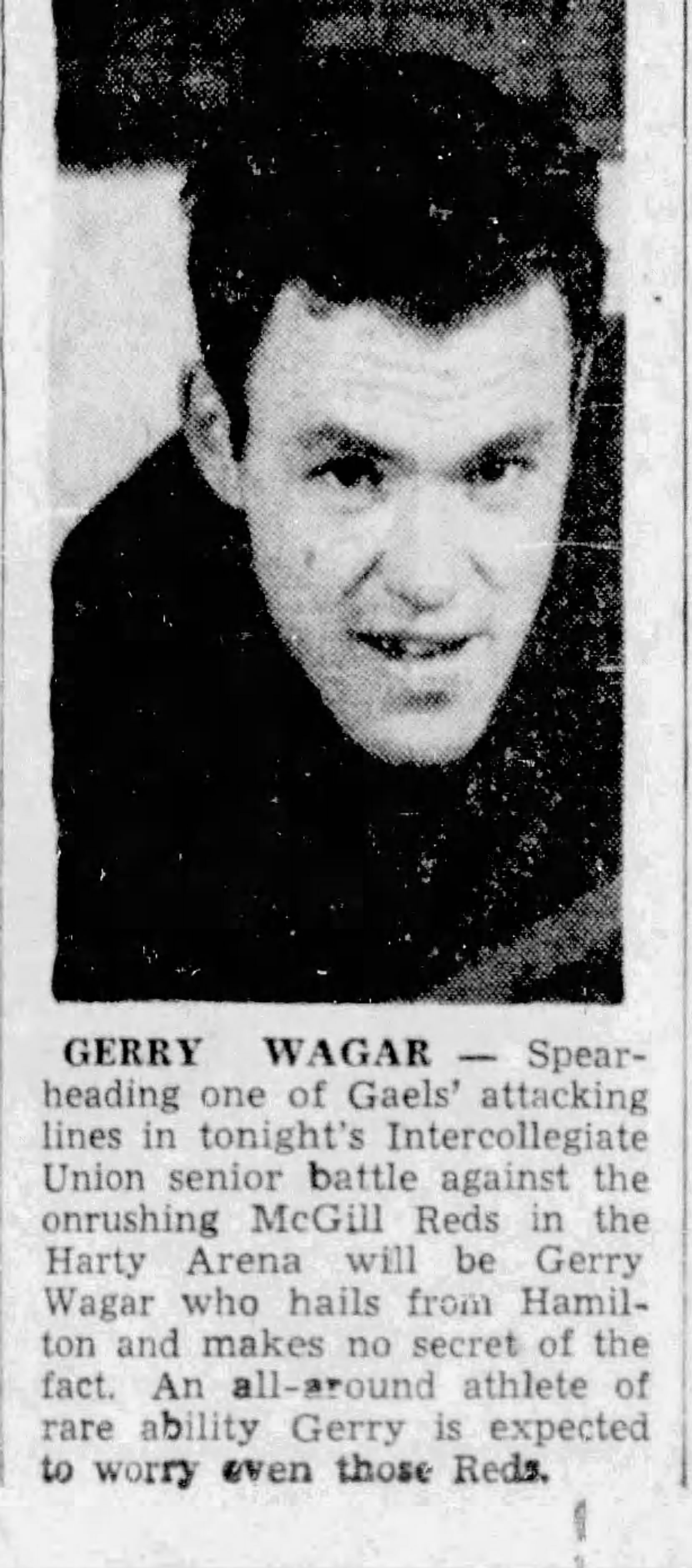
Born in 1921, he spent his formative years in Tweed, ON, and played sports in Belleville. The smooth centre garnered attention while playing for the Belleville Junior ‘B’ team and in 1941 earned an Ontario Hockey Association scholarship to attend McMaster University in Hamilton.
At Mac, he also played three varsity sports, led the hockey team in scoring, was a halfback on the football team and was the men’s singles tennis champion.
His time at McMaster was interrupted by WWII when he joined the Royal Navy Fleet Arm to train as a pilot stationed at Portsmouth, England. He told the Whig Standard he remembered Christmas Day in 1944 with long-time friend Kevin Kennedy, they ventured off to Brighton to find a local rink and a game of shinny. Also, on the ice that day was Maple Leaf’s legendary goaltender Turk Broda, who was stationed nearby.
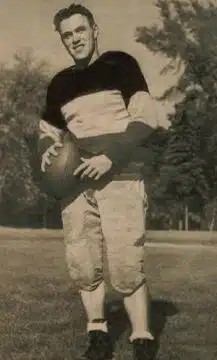
After his time overseas he returned to Hamilton to finish a science degree in Math & Physics before heading to Kingston for Queen’s School of Medicine. Then it was off to Boston, MA where he did his medical specialty and two of his kids were born, Kim and Laura.
Returning to Kingston he would spend fifty years in his psychiatry practice, and was active playing Senior hockey and in the top local baseball and softball leagues. But it was much later he found his true calling; a cerebral coach and student of the game he coached Kingston teams to a string of significant championships in both hockey and baseball in the 1970s & 1980s.
He started managing the Kingston Ponies in 1968 and in 1973 guided the Ponies to an Ontario Senior ‘A baseball championship and a berth in the Canadian finals in New Brunswick.
Dave Trembley, from Carthage, NY, was a catcher on that ’73 championship team. Thirty-five years later he was a big league manager with the Baltimore Orioles. While in Toronto for a series against the Blue Jays, Trembley told the Whig’s Patrick Kennedy that Wagar taught him important baseball and life lessons he took with him to the big leagues. “I learned from Doc Wagar the importance of having the same demeanour day in, day out, no matter how your team is playing.” Tremblay added, “It did not mean Doc was not competitive. He was. But he stayed on an even keel, which I later learned is especially important for young players. Whether that Kingston club won or lost, the next day Doc would be the same calm, supportive manager.”

Doc was a man of few words. One night the Ponies were on the road with starting pitcher Rod Leeder getting roughed up in the first inning, giving up three hits and a couple runs with nobody out. Catcher Rick Senior made a visit to the mound, followed by Doc. He asked Senior how Leeder was throwing, “I don’t know Doc, I haven’t caught anything yet.” The laughter cut the tension, and the Ponies got out of the inning.
During fourteen seasons managing the Ponies, Wagar’s teams won two Ontario championships and eight Eastern Ontario titles. He had the same success coaching minor hockey with the Kingston Young Nationals.
Six months after the Ponies went to the Canadian Senior Baseball championships, Wagar’s Kingston Gurnsey midget team, led by Ken Linseman, went to the Wrigley Cup Canadian championships. In the final game in Oshawa broadcast nationally on CTV, Kingston badly outplayed Verdun outshooting them 44-17, but stoned by a red-hot Quebec goaltender they lost 5-3. Fifty years later in a Whig Standard interview, Linseman called it, “The most difficult loss of my career.”
The win that got the Kingston team into the Wrigley Cup tournament will be long remembered by all involved. Playing the much-heralded Toronto Marlboros for the Ontario title in Penetanguishene, ON, Kingston fell behind 5-0 in the second period, but exploded for six goals in the third for a huge 8-6 upset victory. Kim Elliott had three goals for Kingston. Afterwards, Wagar told the Whig Standard, “Watching the Marlies slouch out of the arena made it worthwhile, they had fancy team jackets and their own team bus with the logo on the side. That was the team to beat, and we did. What a happy bus ride home to Kingston.”

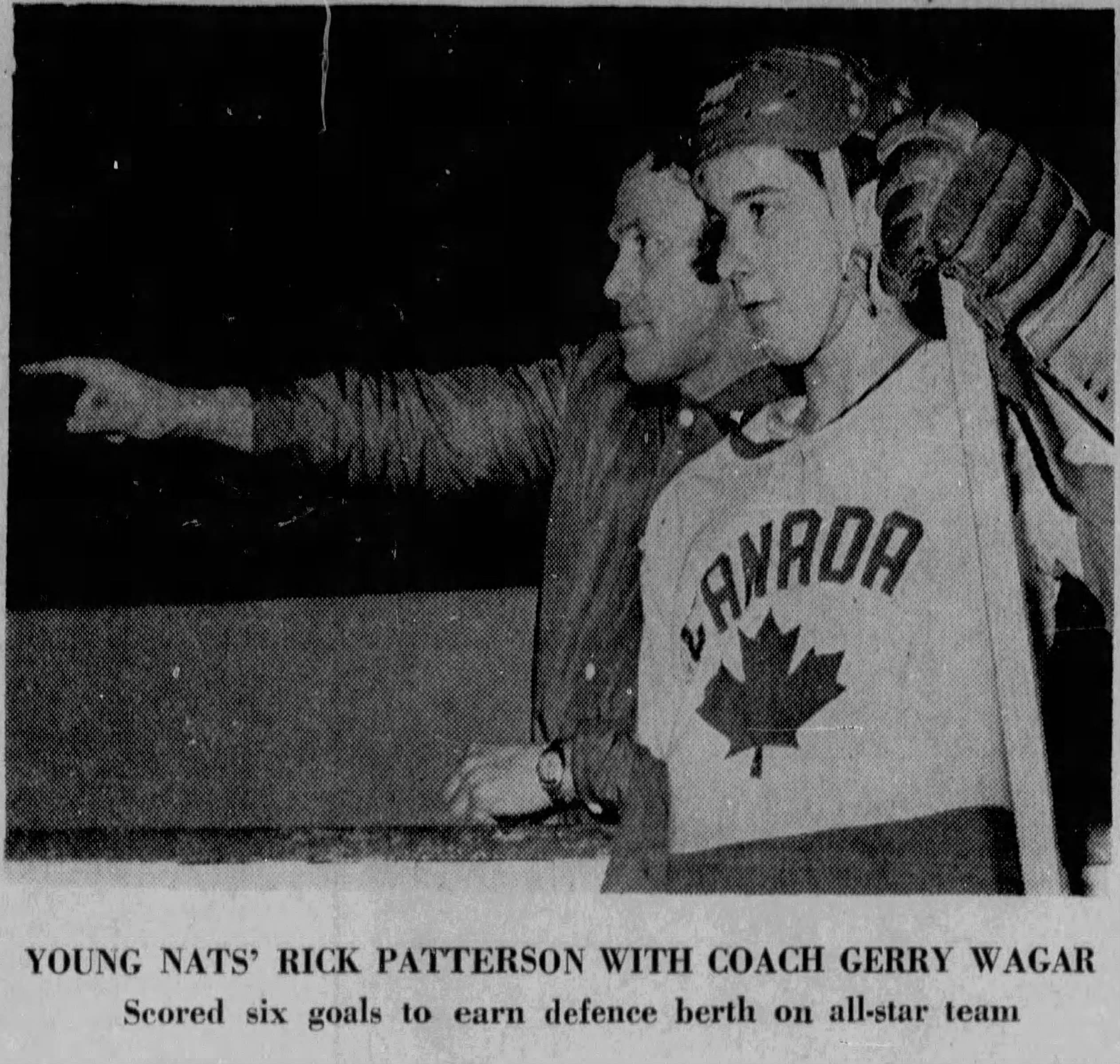
The core players on the Kingston midget team had won the North American Silver Stick Pee Wee tournament in Port Huron, Michigan, three years earlier. That remarkable 1970-71 season they had fifty wins, two losses and one tie. In addition to Linseman, Rick Paterson was a star on the Kingston team, a defenseman who would later play forward at age fifteen with the Cornwall Royals and then in the NHL with Chicago.
Wagar called Paterson, ‘the best Pee Wee aged player in Ontario.” Years later I asked Paterson what he remembered about that Silver Stick win, ‘In the championship final I played the entire game. I never came off the ice, I tried once, and Doc waved me off.” Laughing back at the memory Paterson added, “It was the only time I ever played an entire game without a shift off.” In a three-year stretch Wagar’s teams won an amazing thirteen straight tournaments.
Doc was a student of the game, a quiet, compassionate, unassuming man who admired innovators like Roger Neilson and Howie Meeker.
He enjoyed many great friendships with people like Gord Wood, the legendary Cornwall Royals scout and Richard ‘Wink’ Wilson. Doc and Wood were inducted together into the Kingston Sports Hall of Fame in 2001. Sadly, Wood had passed away the summer before his induction and before knowing he was going into the local sports hall. Wagar is also an honoured member of the McMaster University Sports Hall of Fame.
Doc was a mentor and close friend of Kingston’s Chris MacDonald, now a scout with the Seattle Kraken. When MacDonald coached the Gaels, Doc would help at practice and would travel with the team. At the time of his passing MacDonald told the Whig Standard, “I cannot think of many who played hockey or baseball in Kingston, who were not influenced by Doc Wagar.” Adding, “He was such a sincere man. For the players it was like having their grandfather around.”
He worked in private practice as a psychiatrist until age 87. In his short retirement he continued to review medical journals and took detailed notes watching hockey and baseball games. His daughter, Laura Palango, said of her father, “He was ahead of his time, but never on time.” And you might not know that Gerry Wagar was a musician and accomplished pianist, one of his escapes from medicine and sports.
Busy coaching local sports teams, spending time with family and running a busy medical practice, he found time to help bring Major Junior A hockey to Kingston. Wagar was a key figure and financial contributor to a Kingston group that successfully was able to revive the defunct Montreal Junior Canadiens franchise and bring it to Kingston. In the fall of 1973 Major Junior hockey arrived in town and the Kingston Canadians were born.
Wagar was most proud of his family, his wife and life partner, Geraldine, who predeceased him in 2003, and their three children, Terry, Kim and Laura, along with eight grandchildren.
After coaching and mentoring so many through sports, along with the hundreds of patients he helped through challenging times during his five decades in his medical practice, he passed away in July 2011 just three weeks shy of his ninetieth birthday.
Today, his legacy lives on through all who knew him.
Mark Potter is a long-time Kingston broadcaster & honoured member of the Kingston Sports Hall of Fame. He counts himself among the many who learned from Doc’s wisdom and lessons in living life the right way.

 KTown Sports Blog
We lived in Oshawa at the time. For many years the Kingston vs Oshawa game in the first Wrigley was the largest attended game at the old Civic. My one memory of that tournament was Linseman getting stitched up on the Kingston bench, no freezing, refused to leave the game!
LikeLike
Great story. I love reading about the men and ladies who made the local sports scene what it was in the 60’s and 70’s upwards.
LikeLike